
Editorial
The History of Panerai Explained
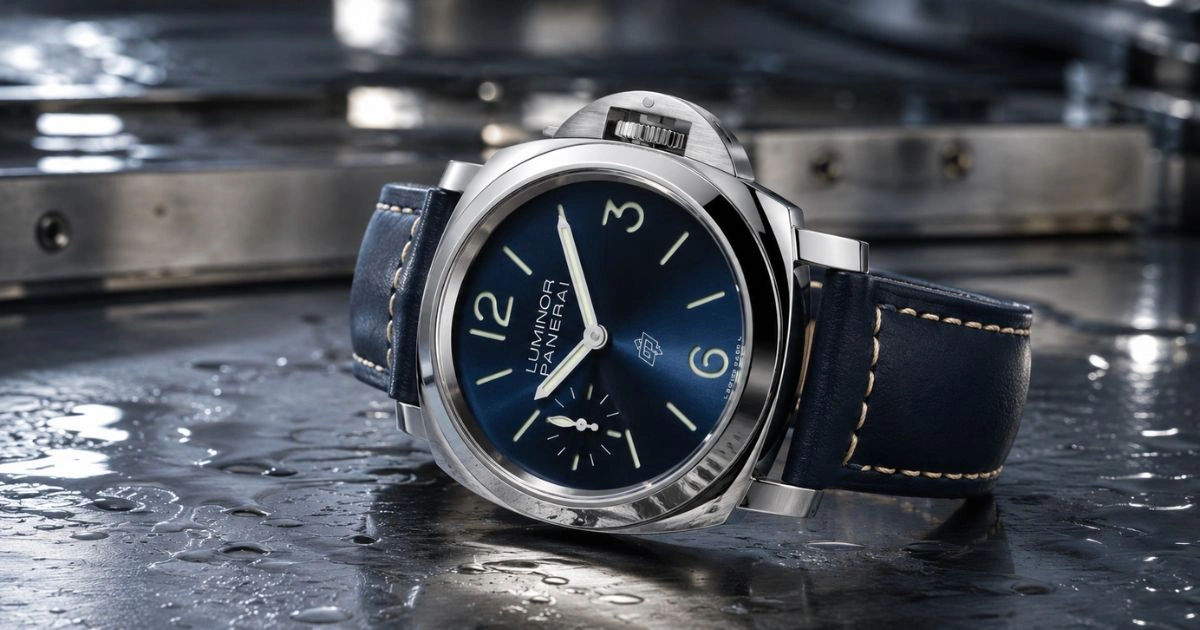
If you look at a Panerai wristwatch, you immediately notice something different. There is no flashy ornamentation, no delicate curlicues, and no need for a magnifying glass to read the time. Instead, you get a massive cushion-shaped case, a dial so clean it looks like a radar screen, and often, a distinctive bridge locking down the winding crown.
In the world of luxury watches, Panerai is the outlier. Most brands started as jewelers making pretty things for aristocrats. Panerai started as a workshop making precision instruments for the Italian Navy.
To understand Panerai is to understand a brand that spent most of its life as a secret. It did not sell to the public for over 130 years. It was a tool, a weapon, and a secret weapon at that. Only in the last three decades has it emerged as a cult favorite, worn by everyone from Navy SEALs to Hollywood stars. This is the story of how a Florentine shop became a horological icon.
The Florentine Origins (1860 – 1915)
Our story begins not in the Swiss Alps, but under the sun of Florence, Italy. In 1860, Giovanni Panerai opened a small watchmaking shop on the Ponte alle Grazie, the bridge connecting the city center to the Oltrarno district.
This was not just a store. It was a workshop, a retail space, and, importantly, the first watchmaking school in Florence. This dual identity—craftsman and educator—became the foundation of the brand’s obsession with technical precision.
Giovanni’s grandson, Guido Panerai, inherited the shop in the early 20th century. Recognizing the industrial shift, Guido moved the business from the bridge to the prestigious Palazzo Arcivescovile (Archbishop’s Palace) in Piazza San Giovanni, right next to the Florence Cathedral. He renamed it “Orologeria Svizzera” (Swiss Watches), a name that still hangs above the door today, signifying a hub for high-quality timekeeping in the heart of Tuscany.
But Guido had bigger ambitions than just selling Swiss watches. He wanted to build instruments. He began supplying the Regia Marina (Italian Royal Navy) with precision compasses, depth gauges, and sighting devices for torpedoes. The relationship between Guido Panerai and the Italian military is the most critical pivot point in the brand’s history.
The Birth of Radiomir (1916 – 1936)
In 1916, Guido Panerai filed a patent for a revolutionary luminescent powder based on radium. He called it “Radiomir”.
The name itself explains its use: “Radio” (radium) and “Miro” (to sight/to aim). This paste made instruments glow in the dark, a vital feature for aiming naval guns or reading a depth gauge in a dark submarine. For two decades, this was just a material used on instruments, not wristwatches.
That changed in the mid-1930s. The Italian Navy was developing “Gamma” assault vehicles—human torpedoes ridden by frogmen to secretly attach explosives to enemy ships (this unit was the precursor to Italy’s COMSUBIN). These frogmen needed a wrist instrument. They needed a watch that could survive the pressure of deep water, be readable in pitch-black darkness, and be strapped over a thick wetsuit.
In 1935, Guido’s son, Giuseppe, commissioned the first prototype. Because Panerai was a small workshop, they did not manufacture movements. They outsourced the mechanics to a giant: Rolex.
Panerai took the Rolex Ref. 2533 pocket watch movement, inserted it into a massive 47mm steel cushion case, and added their Radiomir dial. The result was the Ref. 2533 prototype.
By 1938, this evolved into the Ref. 3646—the first true “Radiomir” wristwatch. Look at this watch, and you see the DNA of every modern Panerai:
- The “Sandwich Dial” : Two overlapping discs. The top disc had cutouts for the numbers; the bottom disc held the Radiomir paste. This allowed for a massive amount of radioactive goo, making it incredibly bright.
- Wire Lugs : Thin metal rods welded to the case to attach long leather straps designed to fit over diving suits.
- Oversized Crown : Easy to grip with rubber gloves.
These were not “luxury goods.” They were explosives rigged to men’s wrists.
The Evolution: Luminor and the Crown Guard (1940 – 1956)
As World War II intensified, the Navy demanded more. The simple wire lugs of the Radiomir were prone to breaking under the stress of the diving suits. The water resistance needed to be absolute.
In the early 1940s, Panerai introduced the Radiomir 1940. The case was thickened, and the lugs were now solid, machined from the same block of steel as the case. It was heavier, tougher, and more brutalist in design.
However, the true revolution came with the invention of the Luminor.
By the late 1940s, radium was understood to be dangerously radioactive. Panerai replaced it with a safer tritium-based compound. In 1949, they patented this new material under the name “Luminor” .
But the name stuck to more than just the paint. It stuck to the new case design.
In the 1950s, Panerai developed the Luminor case to solve the problem of the rubber crown gaskets compressing over time, which let water in. Giuseppe Panerai invented a patented crown-protecting device—a spring-loaded lever that clamps down over the crown, pressing it firmly against the case. This iconic “bridge” is the single most recognizable feature of Panerai today.
In 1956, Panerai produced a massive 60mm version of this watch for the Egyptian Navy, nicknamed the “Egiziano” (Egyptian). It featured an 8-day power reserve movement (from Angelus) because the Egyptian frogmen needed to operate for over a week without winding the watch under their suits.
The Dark Ages & The Secret (1960 – 1993)
Here is the strangest part of the Panerai story: Almost nothing happened for 30 years.
Following the economic decline of WWII, Panerai stopped civilian production entirely. They continued to supply the Italian Marina Militare (Navy) with Luminor watches throughout the 1960s, 70s, and 80s. These watches, often featuring Rolex or Cortebert movements, were produced in tiny batches—sometimes only 30 to 50 units a year.
For a generation, Panerai existed only as a military secret. The brand did not sell watches in stores. They did not advertise. They were ghosts.
This “Secret Years” period is what gives vintage Panerai their insane value today. If you find a *Ref. 6152/1* from the 1960s with a Rolex movement and a “Marina Militare” dial, you are holding a piece of history that auction houses value in the hundreds of thousands of dollars.
Going Civilian: The Renaissance (1993 – 1997)
By the 1990s, the Cold War was over. The Italian Navy no longer needed specialized mechanical watches. Dino Zei, the head of Panerai, faced a choice: close the doors, or try something new.
In 1993, Panerai released three limited series to the public: the Luminor, the Luminor Marina, and the Mare Nostrum chronograph. They were big, bulky, and utterly unlike the thin, elegant dress watches of the 90s.
Purists thought they were absurd. Collectors thought they were fascinating.
The turning point came in 1996. Action star Sylvester Stallone was in Italy filming Daylight (1996). He walked into the Rome Panerai boutique, saw the massive Luminor, and bought several. He liked them so much he commissioned a special series called the “Slytech” for himself and his friends.
When Stallone wore the Panerai in the movie, the secret was out. Watch enthusiasts went crazy trying to find these Italian military beasts.
In 1997, the Swiss luxury conglomerate Richemont (owners of Cartier, IWC, Jaeger-LeCoultre) acquired Officine Panerai. This was the end of the old Panerai and the beginning of the Panerai we know today.
The Modern Era: The “Laboratorio di Idee” (1997 – Present)
Richemont had a master plan. They took the historic blueprints of the Radiomir and Luminor and began mass-producing them with modern Swiss movements. They officially moved the manufacturing to Neuchâtel, Switzerland, in 2002, ensuring the watches met modern luxury standards.
But they kept the heart Italian. The brand’s slogan became “Laboratorio di Idee” (Workshop of Ideas).
This era saw the explosion of Panerai into a global phenomenon.
2025: Panerai continues to innovate with materials (Carbotech, BMG-Tech) and sustainable practices, while maintaining the 47mm and 44mm proportions that scare small wrists and delight collectors.
2005: Introduction of the first in-house movement (P.2002), moving away from modified ETA movements.
2011: Release of the Bronzo, a bronze-cased dive watch that oxidizes uniquely to the wearer, which became an instant “unicorn” (impossible to find at retail).
2019: The Submersible collection officially split off as its own line, focusing on professional diving tools with rotating bezels.
Why Panerai Matters
The history of Panerai is a history of function creating form.
The sandwich dial wasn’t a design trend; it was a way to hold more radium. The crown guard wasn’t a style choice; it was a pressure seal. The 47mm case wasn’t for machismo; it was for reading the time three meters underwater in a murky sea.
For over 80 years, Panerai refused to conform to the jewelry industry. They were engineers supplying soldiers. Today, that authenticity is priceless. When you wear a Panerai, you aren’t wearing a relic of a ballroom. You are wearing a relic of a battleship.
Whether it is the vintage Radiomir or the modern Luminor Marina, every Panerai carries the ghost of Giovanni’s shop in Florence and the courage of the Italian frogmen who carried the originals into the deep.