
Editorial
Panerai History: From Florence to a Global Legend
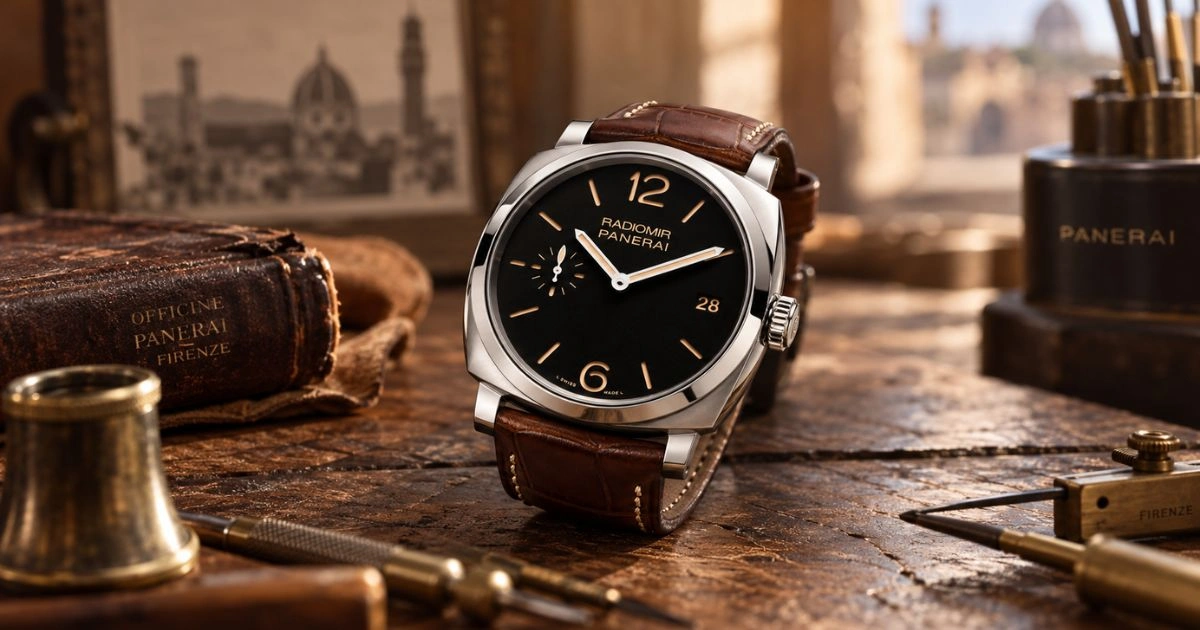
Few watch brands carry a history as captivating and uniquely Italian as Officine Panerai. Born in the heart of Florence during the mid-nineteenth century, Panerai began not as a luxury watchmaker, but as a workshop that supplied precision instruments to the Royal Italian Navy. Its oversized, legible dive watches were once classified military secrets, available only to elite frogmen and commandos. Today, those same design principles—bold cushion cases, luminous dials, and the unmistakable crown-protecting bridge—have made Panerai one of the most recognizable names in luxury horology.
This article explores the complete Panerai history, tracing the brand’s journey from a Florentine watch shop to its evolution as a global icon. Whether you’re a seasoned collector or simply curious about what makes Panerai so compelling, understanding its past is essential to appreciating why its watches command such devotion.
The Origins of Officine Panerai in Florence
Giovanni Panerai opened his first watchmaking shop in Florence in 1860, the same year that saw the formation of the modern Italian state. Located on the Ponte alle Grazie, the shop combined several functions: it served as a watchmaking school, a repair workshop, and a sales showroom. This multifaceted approach laid the groundwork for what would eventually become Officine Panerai.
Florence was a fitting birthplace. As the cradle of the Renaissance, the city had long been a center of scientific excellence, home to figures like Leonardo da Vinci and Galileo Galilei. Galileo himself conducted pioneering studies on oscillation that were crucial to the invention of the pendulum clock. This intellectual environment fostered the precision engineering that would later define Panerai’s instruments.
Under Giovanni’s son, Leon Francesco, the company diversified into research and development, building expertise in mechanical engineering and component fabrication. By the turn of the twentieth century, Giovanni’s grandson, Guido Panerai, had established the firm as an official supplier to the Regia Marina, the Royal Italian Navy.
The Military Partnership That Shaped Panerai
Supplying the Royal Italian Navy
Panerai’s relationship with the Italian Navy began in the early 1900s. Initially, the company supplied a range of technical equipment: timing and contact triggers for mines, submersible navigation tools, and mechanized computing devices. Panerai also produced luminous mechanical calculators for launching torpedoes and depth gauges used by combat divers.
The Invention of Radiomir
A critical breakthrough came between 1915 and 1916, when Guido Panerai developed a self-luminous substance based on radium. This compound, composed of zinc sulphide, radium bromide, and mesothorium, was trademarked as “Radiomir”. The name derives from the Italian “radio mire,” meaning “radium sights”. This innovation allowed instruments to be operated in near-total darkness—a crucial advantage for military operations.
The First Panerai Wristwatch
In 1935, the Royal Italian Navy requested a “special luminous watch for sea divers.” Panerai was chosen over many established watch manufacturers to fulfill the order. Initially, just ten prototypes were produced, exclusively for military use. These early watches, which we now know as the Radiomir, featured a 47mm cushion-shaped case, luminescent numerals, and wire loop strap attachments.
A key aspect of early Panerai watches is that they were actually designed and produced by Rolex, using pocket watch movements from Swiss manufacturer Cortébert. Panerai produced only the dials, which were rendered luminous with their patented Radiomir paste.
The Radiomir: The First Icon
The Radiomir entered permanent service with the Royal Italian Navy in 1938. It quickly became associated with some of the most audacious military exploits of World War II. Commandos and Gamma forces wore these watches during attacks on enemy ships, including the famous raid on Alexandria harbor in 1941, where six Italian commandos disabled two British battleships.
The Radiomir’s design was purely functional. Its large size enhanced legibility underwater. The cushion-shaped case accommodated the substantial movement. The sandwich dial—a two-layer construction with luminescent material between the layers—maximized glow performance. The wire loop lugs allowed the watch to be worn over a diving suit.
The Luminor: Evolution and Innovation
From Radiomir to Luminor
By the late 1940s, Panerai recognized that radium’s radioactivity posed health risks. In 1949, the company patented a new luminescent substance called “Luminor,” based on tritium, a hydrogen isotope. This safer compound would eventually give its name to Panerai’s most famous watch line.
The transformation from Radiomir to Luminor involved more than just the luminous material. The critical innovation was the crown-protecting bridge—a distinctive lever-operated device that sealed the winding crown against water intrusion. This device was patented in Italy in 1955 and in the United States, United Kingdom, and Switzerland in 1960.
The Luminor 1950, as this new model became known, represented a natural evolution of the Radiomir. It retained the same case shape and dial layout but added the crown-protecting bridge and improved water resistance, reportedly up to 200 meters.
The Mare Nostrum Chronograph
In 1943, Panerai developed the Mare Nostrum, its first chronograph, intended for deck officers of the Italian Navy. The prototype featured a massive 52mm steel case containing an Angelus Calibre 215 column wheel chronograph movement. However, the Allied invasion of Italy in September 1943 prevented full-scale production, and only a handful of prototypes were ever made.
The Mare Nostrum would remain a mythical piece for decades, a “what if” in Panerai’s history. Its 1993 reissue for the civilian market would help launch the brand’s modern era.
The In-House Movement Revolution
The P.3000 and P.9000 Calibers
For much of its history, Panerai relied on movements from external suppliers. This changed in the 2000s when the brand began developing its own in-house calibers. The P.3000, introduced in 2011, is a hand-wound movement with a 72-hour power reserve and a large 16½-ligne diameter. The P.9000, a self-winding caliber, also offers a three-day power reserve.
These movements marked a significant shift. They allowed Panerai to control its own destiny, ensuring consistent quality and enabling the development of complications unique to the brand.
The P.2002 and Beyond
In 2005, Panerai equipped the Luminor 1950 with its first in-house movement, the P.2002. This manual-winding caliber featured a GMT function and an eight-day power reserve. Over the following decade, Panerai demonstrated increasing technical mastery, introducing innovations in materials and complications.
From Military Secrets to Civilian Icons
The 1993 Public Launch
For decades, Panerai watches were produced exclusively for military use. That changed in 1993, when Officine Panerai presented its first collection for the civilian public. This consisted of three limited-edition watches: the Luminor, the Luminor Marina, and the Mare Nostrum.
The launch was a significant moment. These watches, inspired by historic military models, quickly became desirable objects for collectors and enthusiasts. The Luminor Marina, in particular, would become a cornerstone of the brand.
Sylvester Stallone and the Rise of Panerai
The brand gained further renown when Sylvester Stallone noticed Panerai watches while traveling in Italy. He had a watch specially made and wore it in the 1996 film Daylight. Stallone commissioned a series of timepieces, some of which featured in his films, significantly boosting the brand’s profile.
This Hollywood connection helped transform Panerai from a niche military supplier into a globally recognized luxury brand.
The Richemont Era
In 1997, the Vendôme Luxury Group—now known as Richemont—purchased Panerai. Under this new ownership, the brand was able to invest in manufacturing capabilities, boutique expansion, and marketing. The decision to remain faithful to the essential features that made Panerai unique—the sandwich dials, cushion cases, and patented crown-locking device—proved instrumental to its success.
Modern Panerai: Innovation and Tradition
Materials and Technology
Today’s Panerai continues to innovate while respecting its heritage. The brand has introduced advanced materials like Carbotech™, a carbon fibre-based composite unveiled in 2015. The LAB-ID™ Luminor 1950 Carbotech™ 3 Days, introduced in 2017, is guaranteed for 50 years and runs without any lubricant.
Expanding the Collection
The Luminor Due, introduced in 2016, broadened Panerai’s appeal with slimmer cases in 42mm and 38mm sizes. The brand has also embraced sustainability, introducing recycled eSteel™ in the Luminor collection in 2021.
The Paneristi Community
Perhaps the most remarkable aspect of modern Panerai is its dedicated community of enthusiasts, known as “Paneristi.” These collectors are drawn to the brand’s unique aesthetic, its military heritage, and its commitment to legibility and functionality. The Luminor 1950, in particular, has attracted a devoted following.
Conclusion
Panerai’s journey from a Florentine watch shop to a global luxury legend is a story of adaptation and authenticity. Founded in 1860 by Giovanni Panerai, the company evolved from supplying precision instruments to the Royal Italian Navy to creating some of the most recognizable watches in the world.
The Radiomir and Luminor, born from military necessity, have become design icons. Their oversized cases, luminous dials, and distinctive crown-protecting bridges are not mere stylistic choices—they are functional solutions that tell the story of their origins. The development of in-house movements like the P.3000 and P.9000 demonstrates Panerai’s commitment to horological excellence.
For collectors and enthusiasts, Panerai represents something rare: a brand whose identity is inseparable from its history. Every Luminor and Radiomir carries the DNA of those early dive watches, created for frogmen who needed instruments they could trust with their lives. That legacy continues to resonate today, ensuring that Panerai’s story—from Florence to the world—remains as compelling as ever.