
Editorial
Rolex Perpetual Padellone: 39mm Anuual Calendar Guide
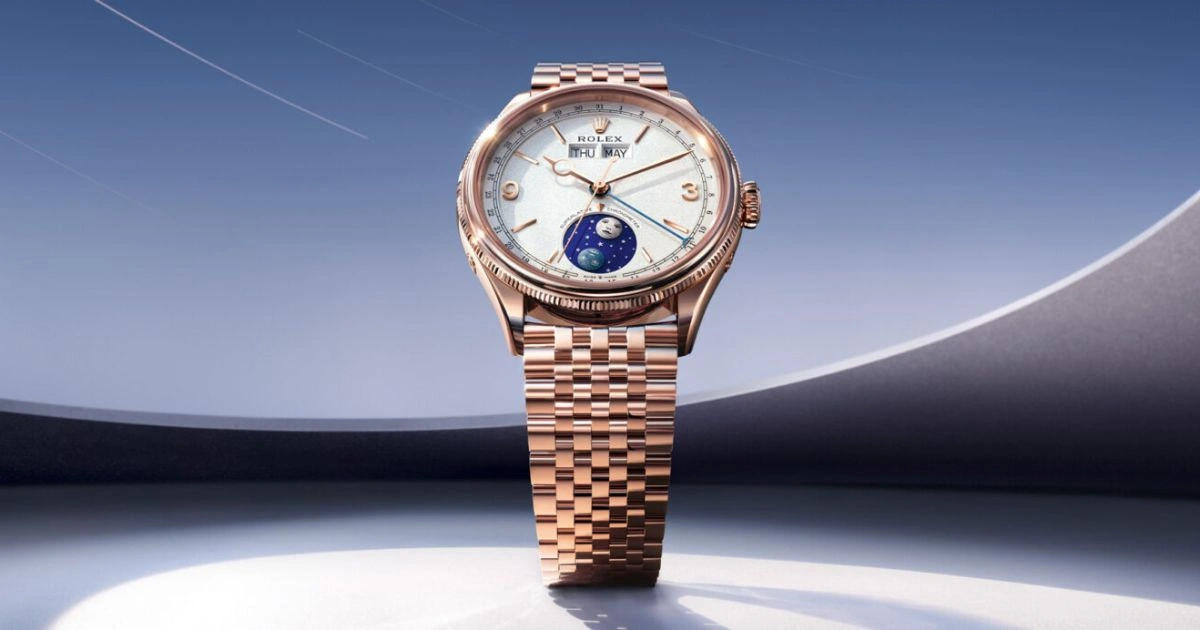
In the rarefied world of luxury watches, few releases generate as much anticipation as a new Rolex. But every so often, the Crown does something truly unexpected. The Rolex Perpetual Padellone is one such watch. Announced outside the usual Watches & Wonders cycle, this 39mm annual calendar with a moonphase display marks a bold departure for Rolex, reviving a nearly forgotten chapter of its history while introducing some of the most advanced movement technology the brand has ever produced. For collectors and enthusiasts, the Padellone represents a rare intersection of vintage heritage and modern horological ambition. This guide explores the history behind the name, the technical brilliance of its new Caliber 7190, and why this watch matters in the broader landscape of haute horlogerie.
The Legacy of the Original Padellone
What Was Reference 8171?
The story begins in 1949, when Rolex introduced the Reference 8171, a triple calendar moonphase watch that was unlike anything else in the catalog. At a time when most Rolex watches were robust, water-resistant Oyster models, the 8171 was a dress watch with a flat 38mm case and a dial crowded with information: day, date, month, and a moonphase display. It was large for its era, and its wide, flat profile earned it the Italian nickname “Padellone,” meaning “large frying pan” among collectors.
The 8171 was produced for only a few years, from 1949 to roughly 1953, and it was never water-resistant like its Oyster siblings. A second reference, the 6062, offered similar complications but within a 36mm Oyster case. Together, these two references remain the only vintage Rolex watches to feature a moonphase, making them highly sought after by collectors today.
A Name Becomes Official
What makes the new Perpetual Padellone particularly notable is that Rolex has officially adopted a collector nickname as the model’s name. Historically, Rolex has never acknowledged the affectionate monikers bestowed by enthusiasts, such as “Paul Newman” Daytona or “Stelline” dials. The decision to embrace “Padellone” signals a rare and deliberate nod to the brand’s vintage heritage and the collectors who have cherished it for decades.
Design and Materials: A Modern Interpetation
Case, Bezel, and Proportions
The new Perpetual Padellone measures 39mm in diameter, 12.2mm thick, and approximately 45.1mm from lug to lug. This makes it just 1mm wider than the original 8171, maintaining the vintage watch’s generous presence on the wrist while offering more contemporary proportions.
The case is available in two precious metals: 18K Everose gold and 950 platinum. The bezel features a distinctive two-level design with a domed upper section and a finely fluted lower section, a subtle detail that echoes the elegance of the 1908 collection while remaining distinct. Water resistance is rated at 50 meters, appropriate for a dress watch that prioritizes refinement over sport utility.
The Dial and Moonphase Display
The dial is where the Padellone’s heritage is most visible. At 12 o’clock, two apertures display the day and month. A central blue crescent-tipped hand points to a peripheral date scale, a layout that directly mirrors the vintage 8171.
The most captivating element, however, is the moonphase subdial at 6 o’clock. The blue enamel disc features full and new moons crafted from genuine meteorite. The new moon is treated with a dark PVD coating, while the full moon retains the meteorite’s natural, crystalline texture. Silver stars are transferred onto the disc, completing a celestial display that rotates once every 29.53 days. This use of meteorite elevates the moonphase from a mere complication to a piece of wearable art.
The Heart of the Watch: Caliber 7190
Movement Architecture and Dynapulse
Beneath the sapphire crystal caseback lies the new Caliber 7190, an automatic movement developed entirely in-house. It is based on the Caliber 7135 introduced with the Land-Dweller in 2025, but with significant modifications to accommodate the annual calendar and moonphase complications.
The movement operates at 5 Hz (36,000 vibrations per hour), a high frequency that enhances stability and precision. It incorporates Rolex’s Syloxi silicon hairspring, a ceramic balance staff, and the Dynapulse escapement—a revolutionary system that reduces friction and improves efficiency. The power reserve is approximately 66 hours, and the movement is certified to Rolex’s Superlative Chronometer standard of -2/+2 seconds per day.
The Haplos Annual Calendar System
The centerpiece of the Caliber 7190 is the “Haplos” annual calendar mechanism. Unlike a perpetual calendar, which accounts for leap years, an annual calendar automatically adjusts for months with 30 and 31 days. The Padellone’s Haplos system requires only a single manual adjustment per year, at the end of February.
What sets this system apart is that the day, date, and month indications all change instantaneously at midnight, jumping in a fraction of a second rather than gradually transitioning. This instantaneous jump is a hallmark of high-end watchmaking, and Rolex has achieved it with a mechanism protected by numerous patent applications.
Collector Context and Comparisons
The Padellone and the Perpetual Collection
The Perpetual Padellone joins the Perpetual collection, which Rolex established in 2023 with the 1908, replacing the Cellini line as the brand’s primary dress watch family. While the 1908 was a relatively simple, time-only design, the Padellone pushes the collection into complicated territory. It shares the 1908’s refined case design and the optional Settimo bracelet—a seven-link, curved-link bracelet that adds a distinctive vintage touch—but offers a far more complex mechanical proposition.
Annual Calendar vs. Perpetual Calendar
For beginners, it is worth clarifying the difference between an annual calendar and a perpetual calendar. A perpetual calendar automatically accounts for leap years and will not require adjustment until the year 2100. An annual calendar, by contrast, recognizes only 30- and 31-day months and must be corrected once a year in February. The annual calendar offers much of the convenience of a perpetual calendar in a simpler, more robust mechanism, and it is the complication that Patek Philippe patented in 1996, a milestone now celebrating its 30th anniversary.
The Padellone’s Haplos system represents Rolex’s own interpretation of this complication, adding its signature instantaneous jump mechanism and the high-frequency Caliber 7190. It is a distinctively Rolex approach to a classic complication.
Conclusion
The Rolex Perpetual Padellone is more than a revival of a forgotten reference. It is a statement of intent. By officially adopting the “Padellone” nickname, Rolex acknowledges its own heritage in a way it rarely does. By equipping the watch with the Haplos annual calendar and the Dynapulse escapement, it demonstrates that the brand’s technical ambitions extend far beyond its iconic sports models. The 39mm case, the meteorite moonphase, and the instantaneous calendar jump all point to a watch designed for collectors who appreciate subtlety, complexity, and craftsmanship. For anyone seeking a modern Rolex with genuine horological depth, the Padellone deserves a place at the top of the list.