
Editorial
Rolex Perpetual Padellone: New 39mm Annual Calendar
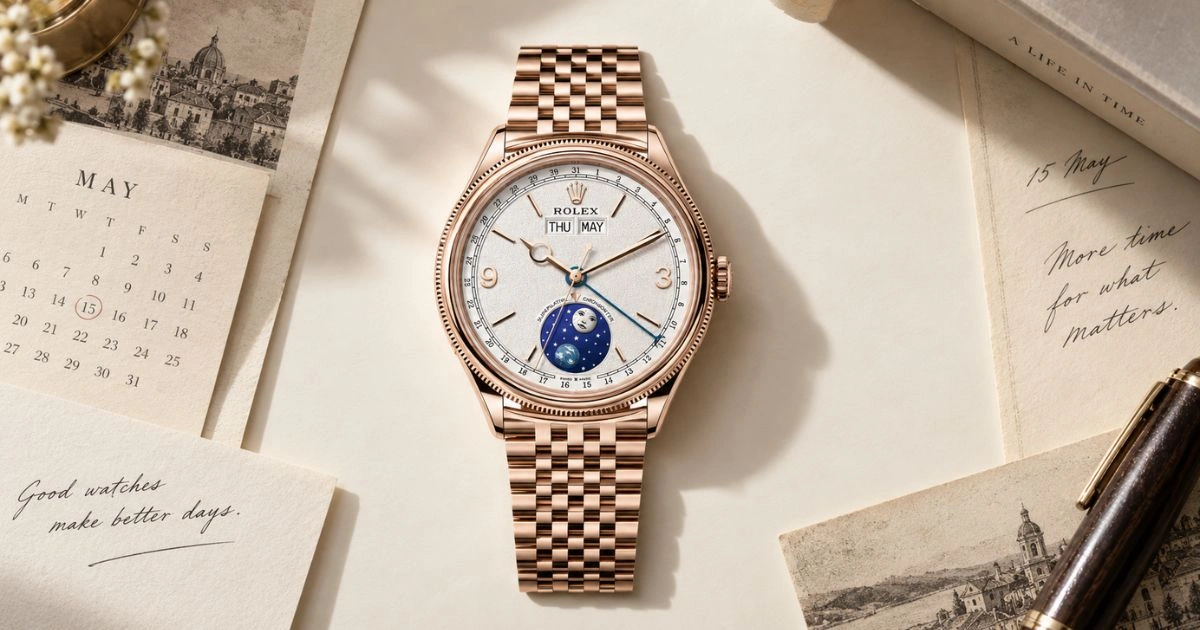
Rolex rarely surprises. The Crown’s annual releases follow a rhythm so predictable that collectors can often guess the year’s novelties months in advance. Every so often, however, the brand reaches into its own archives and pulls out something genuinely unexpected. The Rolex Perpetual Padellone, a 39mm annual calendar with moonphase, is precisely that kind of surprise—a watch that revives a forgotten mid-century reference while introducing some of the most sophisticated calendar engineering Rolex has ever produced.
Announced not at Watches and Wonders in April, but in Milan in September, the Perpetual Padellone arrives as only the second model in Rolex’s dressier Perpetual collection, following the 1908 introduced in 2023. It carries a name that collectors coined decades ago, a complication Rolex has not offered in serial production since the 1950s, and a movement built from the ground up around an entirely new annual calendar system. For enthusiasts, it represents a collision of heritage and innovation that the brand has not delivered in generations.
The Legacy of the “Padellone”
The Original Reference 8171
To understand why this new watch matters, one must first understand the nickname it carries. “Padellone” is Italian for “large frying pan,” and it was Italian collectors who first applied the term to Rolex reference 8171, a triple-calendar moonphase wristwatch produced between 1949 and 1952. The nickname referred to the watch’s unusually wide 38mm case, which was remarkably large for the era and had a profile that some felt resembled a cooking pan.
The reference 8171 was, alongside the reference 6062, one of only two vintage Rolex models ever produced in serial with a calendar and moonphase complication. The two references shared much of their mechanical DNA but differed in one crucial respect: the 8171 featured a snap-on case back, while the 6062 was equipped with a screw-down Oyster case, making it water-resistant. The 6062 also measured a more modest 36mm, making the 8171 the larger and rarer of the pair.
Production of the 8171 was limited—roughly 1,000 examples are believed to have been manufactured across yellow gold, pink gold, and stainless steel. Its rarity, combined with its status as one of Rolex’s most complicated vintage creations, has made it a grail for collectors. Auction appearances are infrequent, and examples in good condition command considerable attention.
Why the Name Matters
Rolex has never officially adopted collector nicknames in the past. “Paul Newman,” “Kermit,” “Pepsi,” and “Batman” remain purely enthusiast shorthand. The decision to name this new model the Perpetual Padellone is therefore significant. It signals that Rolex is not merely reissuing a vintage design but consciously positioning this watch as the spiritual and technical descendant of one of its most storied references. The “Perpetual” portion of the name comes from Rolex’s Oyster Perpetual self-winding movements, while “Padellone” anchors the watch firmly in its mid-century heritage.
Design: Restraint with Presence
Case and Proportions
At 39mm in diameter and 12.2mm thick, the new Perpetual Padellone is just one millimeter wider than the original 8171, yet it sits slimmer on the wrist. That subtle enlargement modernizes the proportions without betraying the character of the vintage original. The case is available in two metals: 18K Everose gold and 950 platinum. The Everose version is offered on either a matte brown alligator strap or Rolex’s new Settimo bracelet, while the platinum version comes exclusively on a matte black alligator strap.
The bezel represents one of the most notable departures from the original. Where the vintage 8171 featured a polished, rounded bezel, the new model employs a domed, subtly fluted design—the upper portion smooth and the lower portion fluted, creating a silhouette that feels both classical and contemporary. It is a detail that rewards close inspection and demonstrates Rolex’s attention to evolving a design language rather than simply reproducing it.
The Dial: A Study in Legibility and Whimsy
The dial of the Perpetual Padellone is where the watch’s personality truly emerges. Rolex has chosen a grained finish that gives the surface a subtle, almost paper-like texture. The Everose model features an intense white dial, while the platinum version is paired with an icy blue dial.
The calendar indications are arranged with a clarity that belies the complexity beneath. Day and month are displayed in two apertures at the twelve o’clock position, while the date is indicated by a blued central hand with a crescent-moon tip that sweeps around a peripheral date scale. This “pointer date” arrangement is unusual for Rolex and keeps the dial uncluttered while maintaining instant readability.
At six o’clock, a blue enameled moonphase disc completes a rotation every 29.53 days. The full and new moons are crafted from meteorite, and the pad-printed faces on these lunar discs are a direct—and charmingly eccentric—nod to the original Padellone, whose moonphase display featured similar whimsical facial details. It is a small touch, but one that connects the new watch to its ancestor in a way that specifications alone cannot.
The Calibre 7190: Engineering a New Calendar
The Haplos System Explained
The heart of the Perpetual Padellone is the new calibre 7190, a movement developed exclusively for this watch and built upon the architecture Rolex introduced with calibre 7135 in the Land-Dweller. The headline feature is the Haplos system, Rolex’s patented annual calendar mechanism.
For readers unfamiliar with calendar complications, the distinction between annual and perpetual calendars is important. An annual calendar automatically adjusts for months with 30 and 31 days, requiring only one manual correction per year—at the end of February, when the calendar must be advanced to March 1. A perpetual calendar goes further, accounting for leap years and theoretically requiring no adjustment until the year 2100. The Haplos system uses two additional components within the instantaneous date mechanism to recognize the difference between 30- and 31-day months, allowing the day, date, and month to change simultaneously at midnight.
This is a significant technical achievement. Annual calendars are less complex than perpetual calendars, but Rolex has chosen to implement the complication with an instantaneous jump rather than the gradual creep found in many calendar watches. The result is a calendar that feels decisive and precise, with all indications snapping into place at the stroke of midnight.
Movement Architecture and Performance
The calibre 7190 is a high-frequency movement, beating at 5 Hz (36,000 vibrations per hour)—a rarity for Rolex, which has historically favored 4 Hz movements for its reliability and service intervals. It achieves this through the Dynapulse escapement, a sequential distribution escapement introduced in the Land-Dweller that replaces the traditional Swiss lever escapement. Key components of the escapement are made from silicon, providing resistance to magnetic fields, while the Syloxi hairspring, ceramic balance staff, and optimized brass balance wheel further enhance precision and durability.
The movement offers approximately 66 hours of power reserve, making it practical for weekend wear without the need for a winder. It is Superlative Chronometer-certified, meaning it meets Rolex’s internal standards for precision, which are stricter than those of COSC. Through the sapphire case back—a feature rarely seen on Rolex watches outside the Cellini and Perpetual collections—the movement is visible, finished with Rolex’s Côtes de Genève decoration.
Setting the Calendar
One practical consideration worth noting is how the calendar is set. The Perpetual Padellone features four correctors—two on each side of the caseband—used to adjust the calendar indications and moonphase. Some collectors may find this arrangement less convenient than crown-based setting, but it is a common approach for complicated calendar watches and preserves the integrity of the crown’s winding and time-setting functions. Despite the additional case openings, water resistance remains at 50 meters.
Context and Comparisons
How It Differs from the Sky-Dweller
Rolex’s only other current annual calendar is the Sky-Dweller, introduced in 2012. The Sky-Dweller combines an annual calendar with a GMT function and a distinctive off-center 24-hour disc, presenting the calendar information through a series of windows around the dial rather than subdials or pointer hands. The Perpetual Padellone takes a more traditional approach, placing the calendar indications in apertures and a peripheral date track. Both are annual calendars, but they serve different purposes: the Sky-Dweller is a travel-oriented complication, while the Padellone is a dress watch with an emphasis on classical calendar display.
The Moonphase Connection
Moonphase complications have been rare in Rolex’s modern catalog. The Cellini Moonphase, launched in 2017, was the last Rolex to feature the complication before the Perpetual Padellone. The Cellini Moonphase’s lunar display was accurate for 122 years, a remarkable figure achieved through a 135-tooth gear train. The Perpetual Padellone’s moonphase disc completes a rotation every 29.53 days, tracking the synodic month, and its meteorite moons give it a tactile, material quality that distinguishes it from painted or enameled alternatives.
The Settimo Bracelet
For those who prefer a metal bracelet, Rolex has developed the Settimo, a seven-link bracelet engineered to be lighter than the brand’s traditional offerings. It relies on a patent-pending case attachment system and is available exclusively with the Everose gold Perpetual Padellone. The bracelet is fully polished, giving it a jewelry-like quality that suits the watch’s dressy character, and its lighter construction addresses a common complaint about solid gold bracelets on complicated dress watches.
Why This Watch Matters
The Perpetual Padellone is significant on several levels. Historically, it resurrects a reference that has been absent from Rolex’s catalog for over seventy years, bridging the gap between the brand’s postwar golden age and its contemporary engineering capabilities. Technically, it introduces the Haplos system, a new approach to annual calendar mechanics that may well find its way into other Rolex models in the future. Aesthetically, it demonstrates that Rolex is willing to produce dress watches with genuine horological ambition, not merely variations on its sports watch formula.
For collectors, the watch offers something rare: a Rolex complication that is not a chronograph, a GMT, or a dive timer. It is a calendar watch in the classical sense, with a moonphase rendered in meteorite and a pointer date that recalls mid-century watchmaking conventions. It is also a watch that invites daily wear, with a reasonable 39mm case, 50-meter water resistance, and a 66-hour power reserve.
The Perpetual Padellone is not a revival in the nostalgic sense. It does not attempt to recreate the reference 8171 piece for piece. Instead, it takes the spirit of that watch—its ambition, its complexity, its willingness to be different—and translates it into a modern idiom. In doing so, Rolex has created something that feels both inevitable and unexpected, which is perhaps the highest compliment one can pay to a brand so often defined by consistency.
Conclusion
The Rolex Perpetual Padellone is a watch that rewards curiosity. At first glance, it presents as an elegant dress watch with a handsome dial and a familiar name. Look closer, and it reveals a movement built around a patented calendar system, a high-frequency escapement borrowed from the Land-Dweller, and a moonphase crafted from meteorite. It is a watch that honors the past without being trapped by it, and it signals that Rolex’s Perpetual collection is evolving into a home for the brand’s most interesting and least predictable creations. For enthusiasts who have long wished for a Rolex that feels genuinely new, the Padellone delivers exactly that—a familiar name attached to something the brand has never quite done before.