Editorial
Tudor Northflag GMT 2026: Return of a Cult Classic
There are certain watches that seem to arrive ahead of their time—pieces that collectors only fully appreciate years after they’ve disappeared from catalogues. The Tudor North Flag was precisely that kind of watch. First introduced in 2015 as the brand’s inaugural model with an in-house manufacture movement, it was a bold, angular statement piece that didn’t quite fit the vintage-inspired mould Tudor had become known for. By 2021, it had been quietly discontinued, leaving behind a devoted but relatively small following of enthusiasts who recognised its significance.
Now, five years later, Tudor has brought it back. And they haven’t simply reissued it—they’ve evolved it. The new Tudor Northflag GMT (now styled as a single word) made its debut at Geneva Watch Days 2026, and it arrives with a suite of upgrades that transform this cult favourite into something far more compelling. This isn’t a nostalgia play. It’s a reimagining.
A Name Rooted in Exploration
To understand the Northflag, you have to understand its namesake. The watch draws its identity from the British North Greenland Expedition of 1952, a two-year scientific mission during which Tudor equipped 25 team members with Oyster Prince watches. These timepieces endured the brutal conditions of the Greenland ice sheet—months of polar night, extreme cold, and unforgiving terrain—and emerged with their reliability proven. That spirit of rugged exploration is baked into the Northflag’s DNA.
Design-wise, the original North Flag drew inspiration from the 1973 Tudor Ranger II, a distinctive integrated-bracelet sports watch that stood apart from the brand’s dive-centric offerings. The 2026 Northflag retains those same foundational lines, but with refinements that bring the design firmly into the present.
The GMT Complication: A Natural Evolution
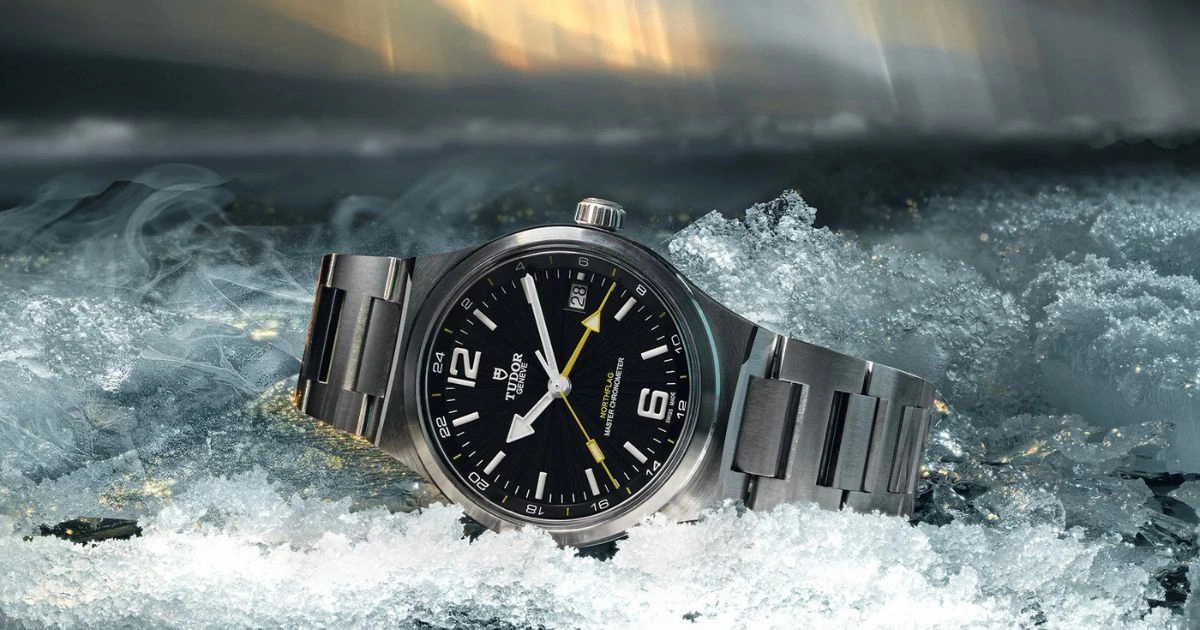
The most significant change is the addition of a GMT function. The original North Flag featured a power reserve indicator at 9 o’clock—a useful complication, certainly, but one that crowded an already technical dial. For 2026, Tudor has replaced that display with a central yellow arrow-tipped 24-hour hand, paired with a 24-hour scale engraved on the rehaut at a distinctive 45-degree angle.
This is a “flyer” or “traveller’s” GMT, meaning the local 12-hour hand can be adjusted independently in one-hour increments without stopping the movement. For anyone who frequently crosses time zones, this is the gold standard—it allows you to reset to local time instantly while the GMT hand continues tracking your home reference.
And the choice of a GMT complication isn’t arbitrary. For a watch rooted in polar exploration—where months of continuous daylight or darkness make conventional AM/PM distinctions virtually meaningless—a 24-hour display is genuinely practical. It’s a function that serves the watch’s identity rather than simply adding a complication for its own sake.
Design: Familiar Yet Refined
At first glance, the new Northflag is unmistakably its predecessor’s descendant. The 40mm stainless steel case retains the same angular, assertive silhouette, with a mix of satin-brushed and polished surfaces. The black dial is still punctuated by those signature yellow accents—on the seconds hand, the new GMT hand, and the tip of the 24-hour hand. Without that pop of colour, the Northflag could easily become just another black-dialled sports watch. With it, it’s instantly recognisable.
But look closer, and the refinements become apparent. The hour markers are now crafted from monobloc ceramic and filled with Grade A Super-LumiNova, ensuring exceptional low-light visibility. The case is slightly slimmer than its predecessor at 12.7mm thick, and the lug-to-lug distance of 48.8mm ensures a comfortable fit on a wider range of wrists. The screw-down crown contributes to 100 metres of water resistance—more than adequate for a watch that’s meant for adventure rather than deep diving.
Perhaps the most welcome refinement is the dial itself. With the power reserve indicator removed, the layout is cleaner, more balanced, and easier to read at a glance. The date window at 3 o’clock remains, but it no longer competes for visual real estate.
The Integrated Bracelet
The Northflag’s two-link integrated bracelet is another area where Tudor has raised its game. The bracelet flows seamlessly from the case, creating a continuous visual line that reinforces the watch’s cohesive design. The H-link construction combines predominantly brushed surfaces with polished chamfers, giving it a refined yet rugged character.
The real story here is the clasp. Tudor’s T-fit rapid-adjustment system allows for tool-free micro-adjustment across 8mm of range, meaning you can dial in the perfect fit whether you’re wearing the watch over a jacket sleeve or directly against bare skin. Ceramic ball bearings within the clasp ensure smooth, secure operation—a small detail that speaks to the overall quality of the package.
Inside the Movement: MT5652-U
Under the sapphire display caseback beats the heart of the new Northflag: the manufacture Calibre MT5652-U. This automatic movement operates at 4 Hz (28,800 vibrations per hour) and delivers a 65-hour power reserve—enough to take it off on Friday evening and pick it up on Monday morning still running.
But the real headline is certification. The MT5652-U carries both COSC chronometer certification and METAS Master Chronometer certification—a dual achievement that places it among the most rigorously tested movements in its class. METAS certification subjects the fully assembled watch to a battery of tests: precision across two temperatures and six positions, water resistance verification, power reserve confirmation, and resistance to magnetic fields up to 15,000 gauss. The daily precision requirement is an astonishing 0 to +5 seconds per day—tighter even than COSC’s -4 to +6 standard.
The use of a silicon balance spring is key to this anti-magnetic performance. In an age where smartphones, laptops, and magnetic closures are everywhere, a movement that shrugs off magnetic interference is no longer a luxury—it’s a practical necessity.
Why the Northflag Matters Now
When the original North Flag launched in 2015, the luxury sports watch market was a different landscape. Integrated bracelet designs hadn’t yet experienced the renaissance they enjoy today. The watch was perhaps a bit too unconventional, a bit too forward-thinking, for its moment.
Today, the context has shifted. Integrated-bracelet sports watches are everywhere, and GMT complications have become the traveller’s essential companion. The Northflag GMT arrives not as an outlier but as a confident offering in a crowded field—one that distinguishes itself through genuine heritage, technical credibility, and a design language that’s entirely its own.
There’s also something to be said for Tudor’s willingness to evolve rather than simply reissue. The brand could have brought back the North Flag unchanged, relying on nostalgia to drive sales. Instead, they’ve listened to what collectors appreciated about the original and addressed what they didn’t. The result is a watch that honours its predecessor while standing confidently on its own merits.
Conclusion
The Tudor Northflag GMT 2026 is proof that some watches simply need the right moment. What was once a cult favourite has returned as something more complete—a rugged, technically accomplished GMT that wears its polar exploration heritage with quiet confidence. The addition of the GMT complication feels less like an upgrade and more like a fulfilment of the watch’s original promise. The METAS certification and refined design details elevate it without sacrificing the distinctive character that made the North Flag special in the first place.
For collectors who missed the original, this is a second chance. For those discovering the Northflag for the first time, it’s an introduction to one of Tudor’s most compelling and individualistic designs. The cult classic is back—and this time, it might just be ready for the mainstream.